Women's Philharmonic Advocacy
facebook

Music by Florence Price Featured by the Chicago Symphony and Others.

A Conversation with Conductor Mei-Ann Chen

by Liane Curtis - May 13, 2013

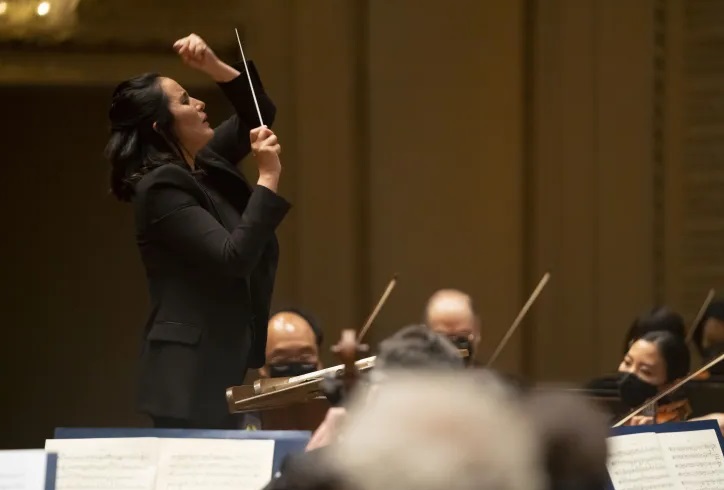
Mei-Ann Chen is Music Director of the Memphis Symphony and the Chicago Sinfonietta.  Earlier this year she guest-conducted with the San Diego Symphony, and on May 9 she made her subscription debut with the Chicago Symphony.  This is four orchestras and their audiences to whom she has introduced the music of Florence Price.

A few weeks ago she was kind enough to take a few moments from her busy schedule and talk with me about how this all came about.

Liane Curtis:  I just recently discovered what you are doing when I saw they were going to play the “Mississippi River” Suite in Chicago. So I want to ask you about her, about Florence Price.

MEI-ANN CHEN:  I have to admit I didn’t know much of Florence Price’s music before Martha Gilmer of the Chicago Symphony approached me with her Mississippi River.  Martha has been the Vice President for Artistic Planning and Audience Development with the Chicago Symphony for a long time, and obviously Florence Price being very special to Chicago Symphony’s history, I think she has been waiting for the right conductor to come along.  …  It will kick off the Rivers Festival that was sugested by Yo-Yo Ma.  Yo-Yo has an official role as a Creative Consultant with the Chicago Symphony now.

Martha has been following my career because she has family from Memphis…her family there has been sort of the ‘spy’ [laughs] for Martha and what’s happening with Memphis.  And one thing led to another.  So when Martha approached me and said “how would you like to do this piece?”  I said “Oh my gosh, I totally don’t know this composer.” …

I just read the blog that you have—it’s wonderful that you are continuing to advocate for women composers.  So, this year, as you know I have done “The Oak” [also by Florence Price] with Chicago Sinfonietta, and there’s one more piece that I’d like to mention because it’s a hidden jewel.  We had to change one of the programs in Memphis … so I thought it would be a nice opportunity to find another piece by Florence Price for our audience to learn about her work in preparation for the Mississippi River that we’re doing to end our Masterworks season.

And so I found another piece by Florence Price, I don’t know if you know, it was originally written for piano, called “Dances in the Canebrakes.”  William Grant Still orchestrated it for her, even though she knew how to write for orchestra, but I don’t know, maybe they were such good friends that William Grant Still thought this piece really deserved an orchestral treatment. It’s so delightful!  But I can tell you when we got the parts from the publisher our librarian was a little bit horrified … It just looked like it hasn’t really been performed with an orchestra.  So we actually got permission from the publisher to create a set [of parts] that our musicians can use.  That way the publisher could continue to use this very well-made set for other orchestras.

So I’m going to do that again with Chicago Sinfonietta coming up in June for our Annual Ball, which is the largest fundraising event for the Sinfonietta … a lot of African-American community leaders will be attending.  And in the same concert we will also be previewing our next season in which we will be doing the last two movements of Florence Price’s Symphony in E, which is Symphony No. 1; it was premiered by the Chicago Symphony in 1933.

LC:  Great!  That’s good to know! So you’re doing “Dances in the Canebrakes” in Memphis?

CHEN:  We just did it in January.  And I will be doing it also with the Chicago Sinfonietta coming up in June.  And they’re such delightful pieces, and really orchestrated well, but nobody knows!  We’re also trying to spread the word to other orchestras. It might be wonderful for people to consider programming it.

LC:  I know you did some Florence Price in San Diego because I sold a lot of CDs there [The Women’s Philharmonic CDs that we sell on our website]. 

CHEN:  Oh, wonderful!  Yes, I did Mississippi River in San Diego in February this year.  I’m scared to do anything for the first time in front of the Chicago Symphony.  And so it was actually a wonderful thing that San Diego had this response when I pitched it, they said “Sure, why don’t we do it here!”  And I have to tell you the librarian there, Courtney [Cohen] was so wonderful because she compiled a 10-page errata list for the piece.  You might be able to help us to solve this mystery, because it’s been recorded by The Women’s Philharmonic, so there must be a good set somewhere where all the wrong notes were caught…because the recording has the correct pitches compared to the many misprints in the parts she received for the San Diego program.   Courtney said she couldn’t find that set used by the recording used for the recording, so she actually had to start from a brand new set.  But the wonderful thing is this 10-page errata list compiled by Courtney will go on to the Chicago Symphony for my next performances in May and to Memphis as well; it will save a lot of rehearsal time for both—and future—orchestras.

LC: The thing about The Women’s Philharmonic, when they shut down in 2004, there’s been a dispersal of their collection and their knowledge.

CHEN:  I see.  Hopefully now the piece can become mainstream and at least we have done a lot of the footwork, the hard work for it, that will make it easier for other orchestras to do it now.

LC:  Just on another subject, I know that you’re traveling so much and you go back and forth between Chicago and Memphis?

CHEN: Right. Because I’m Music Director to both Memphis Symphony and the Chicago Sinfonietta, (the latter being the most diverse orchestra in the country, founded to promote minority musicians of all kinds).  The Chicago Sinfonietta is unique with its mission.  Soloists, conductor, musicians…and it was very specific when Maestro [Paul] Freeman founded it, to promote African-American musicians and Latino musicians, so my appointment as Maestro Freeman’s successor surprised a lot of people.   However, being in such a diverse world, it’s a goal for us to embrace  more of a global diversity.  But I think Maestro Freeman has also been promoting women composers and so it’s neat that even though Florence Price was probably not a composer whose music he had come in contact with, it fits nicely in terms of in my Chicago Symphony debut that I’m able to champion for an African-American woman composer.

LC:  Great.  Wonderful.  So are both cities home for you now? 

CHEN:  Yes, Memphis is larger in budget size and so the longer season requires more of my residency.  I spend 18 weeks in Memphis, and 12 of the 18 are conducting weeks.  Now, in Chicago I spend eight to ten weeks a year and I consider myself also a Chicagoan.  Our Sinfonietta season is a lot smaller in size.  I conduct four concerts with the Chicago Sinfonietta, but there are other projects.  For example we have a program called Project Inclusion, which is about to really gain national recognition from major foundations. It’s probably the only program that creates opportunity not only in small ensembles but also in side-by-side opportunity for music students who haven’t yet garnered enough experience to land a professional position in either an orchestra or a teaching position.

And so it’s really a small orchestra, but with mighty impact in the industry.  For example, the Grant Park Festival Orchestra, which is quite well known, serves the Chicago Millennium Park with free concerts in the summer. We are going to begin a partnership as part of our Project Inclusion; participants will be playing side-by-side with their professional musicians this upcoming summer season.   And so we are hoping to use my professional network, and our wonderful Executive Director Jim Hirsch’s professional network, to pitch a similar concept to other professional orchestras to encourage more presence of minority musicians among the symphonic world in our country, and to also encourage those …who don’t really grow up with classical music—it’s so important that they get exposed to it as much as possible.

LC:  That’s fantastic! 

CHEN:  And I hope you will include “Dances in the Canebrakes” on your blog because they’re really delightful pieces.  There’s a recording of the piano version but there is no commercial recording yet available of the orchestra version.  My first commercial disc is coming out very soon, featuring the Harlem Quartet [and the Chicago Sinfonietta], with one world premiere and pieces that are out of print.  I already told Jim Hirsch my hope for the next recording project: to include Florence Price, at least the “Dances in the Canebrakes” for sure.

LC:  Oh great, fantastic.  Excellent!  I’ll look forward to that and thank you so much again. 

CHEN:  Thank you for all you’re doing to advocate for women composers!

[And thanks to Susan Brown for her help in transcribing this interview.]

Making Waves with the Mississippi River Suite: Mei Ann Chen Brings Florence Price’s Music to Chicago Symphony

by Liane Curtis - May 11, 2013

Acclaimed conductor Mei-Ann Chen is just completing her first year as Music Director of the Chicago Sinfonietta.  And Thursday she made her debut as a guest conductor of the Chicago Symphony Orchestra‘s subscription series.  She made quite a  ”splash” with Florence Price’s Mississippi River Suite—the press has been filled with praise for the inspired leadership she brings to this work.

The Chicago Tribune’s John von Rhein enthuses that “Chen clearly believes in the musical merits of ‘Mississippi River,’ and she succeeded in transferring her admiration to the orchestra”—and the audiences as well!  Dating from 1934, ” the suite is attractive, tuneful, nostalgic, cannily scored, direct of expression,”  and and example of   “unabashed populism.”   “Is a Florence Price renaissance upon us?”  asks von Rheim.  Clearly the answer is “yes,” if we follow Chen’s activities—she led the San Diego Symphony in the Mississippi River Suite in February, and will bring the work to her Memphis Symphony next weekend.  She already performed Price’s “Dances in the Canebreaks” (as orchestrated by Price’s friend William Grant Still) in January in Memphis, and will bring it to the Chicago Sinfonietta on June 1.

Describing the Mississippi River Suite, Wynne Delacoma  (writing in the Chicago Classical Review) was moved to write in detail:

 In the last movement, solo instruments came and went like musicians heard on a nearby shore, a moody trumpet or glowing horn or ardent cello playing snatches of such spirituals as Nobody Knows the Trouble I’ve Seen and Go Down, Moses. Spiced with bits from popular songs of the 1900s, the musical layers came together in a jaunty mashup. But in the closing bars the river once again smoothed out into a gently flowing undercurrent and the call of a lonely harp.  …  The concert was an auspicious CSO subscription concert debut for Chen … With luck, we’ll see her again on the CSO podium.

And with luck, more ensembles will be bringing Florence Price’s music to life!
 

Florence Price and the Chicago Symphony Are Reunited—by Mei-Ann Chen

by SMBrown - March 1, 2013

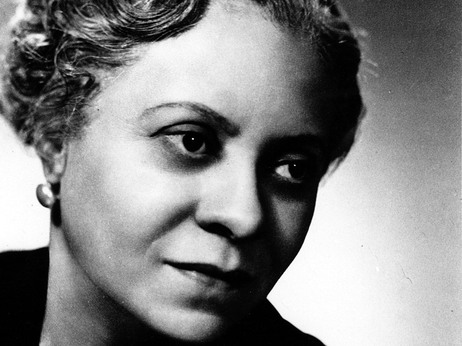
On the cusp of Black and Women’s History Months, we’re celebrating that 80 years after her orchestral debut Florence Beatrice Price is currently making a comeback on the concert stage—thanks in no small part to conductor Mei-Ann Chen.

Florence PriceChen, maestro of both the Memphis Symphony and the Chicago Sinfonietta performed Price’s The Oak as part of a January tribute to Dr. Martin Luther King on the occasion of national remembrances of his birthday. Then, in February, she took the podium to guest-conduct the San Diego Symphony in a performance of Price’s 30-minute tone poem Mississippi River. The latter serves as a warm-up for what will later this spring be the biggest platform for Price (and Chen): a premiere of Mississippi River by the Chicago Symphony Orchestra.

Returning to the Chicago Symphony stage is, of course, a homecoming of sorts for Price. The Arkansas native studied at the New England Conservatory of Music (as did Chen, coincidentally) and although she initially returned home where she taught music and composed short pieces for the piano, the racial tensions and violence in the south during the 1920s eventually precipitated a move to Chicago in 1927. There she became both teacher and student as she availed herself of the many professional opportunities to continue her musical studies with some of the era’s finest teachers.

Blossoming creatively, Price won both first and second place in the prestigious Wanamaker Music Composition Contest with her Symphony in E Minor and Piano Sonata in E Minor. As a consequence, she broke gender and racial barriers by becoming the first woman of African descent to have a symphony performed by a major American orchestra, the Chicago Symphony, at the 1933 Chicago World’s Fair.

Chen will guest-conduct Price’s 1934 Mississippi River for the CSO for five performances this May.

Chen will guest-conduct Price’s 1934 Mississippi River for the CSO for five performances this May.

Mississippi River was composed the following year, and is subtitled “The River and the Songs of Those Dwelling Upon Its Banks.” Presaging Copland, the suite weaves together melodies of traditional folk tunes, African-American spirituals and even one Native-American chant. It will receive five performances beginning on May 9, 2013, as part of the CSO’s Rivers series.

Mississippi River, The Oak and Price’s Symphony No. 3 in C Minor can all be heard on the landmark recording of the Women’s Philharmonic under the direction of Apo Hsu, available in the WPA shop.

Price was a prolific composer, penning an estimated 300 works that range from small teaching pieces to large-scale concertos and symphonies and include chamber music and vocal compositions. Her “eloquent” arrangements were championed by both Eleanor Roosevelt and Marian Anderson, according to the New York City Opera’s Cori Ellison. Nevertheless, much of her work remains unpublished and she has rarely (with the exception of the Women’s Philharmonic) been performed since her death in 1953.

Certainly Price’s gender and race were obstacles to publication and performance, but Ellison also notes that she was branded “conservative” because her romantic, chromatic compositions eschewed the atonality that became the vogue in 20th century music. Yet despite this adherence to Western European forms and techniques Price did innovate, by suffusing her music with deeply spiritual and southern roots, in the form of African-American dance rhythms and folk melodies.

In addition to the above links, Columbia College’s Center for Black Music Research in Chicago is a fabulous resource for all things classical and African-American. Volume 3 of Recorded Music of the African Diaspora (2011), which we highlighted at this time last year, contains not only Price’s Symphony in E Minor, but her Concerto in One Movement, whose score has been partially reconstructed for this project by composer Trevor Weston. Of special note is a comprehensive discography of music by black composers compiled by the Center.

And stay tuned for more on Mei-Ann Chen, whom we hope to feature (and interview!) later this month.

The Long, LONG Arc of History

by SMBrown - August 24, 2012


With the debut of Margaret Ruthven Lang’s Dramatic Overture in 1893, the world changed: never before had an orchestral work composed by a woman been performed on the American stage.  The intervening 119 years have brought monumental social change, much of it due to the ever-increasing participation of women in all aspects of society.  But what of women in classical music?  Concerning female composers, it seems accurate to say that change is frustratingly slow.  Can this perception about their long arc of history be clearly spelled out and quantified?

Our resident researcher Sarah Baer pored over eight seasons (2000-2008) of repertoire data collected and provided by the League of American Orchestras to try to assess what the current landscape for female composers is, as well as to suss out any notable trends that might give us a window into the future.

As noted in analyses for both the 2008-2009 and 2009-2010 seasons, the LAO data, while the most comprehensive available, is still a limited lens.  Not only does it depend on voluntary reporting by its member orchestras, it under-represents smaller regional and university ensembles who tend to seek out more diverse programming.  One must remember, however, that the standard repertoire of large symphony orchestras serves as a beacon to the listening public, signaling what deserves to be heard, and understood by the average layperson about the canon of the Western Classical Music tradition.  So despite its limitations, the information provided by the LAO is of great significance.

The (Sorta) Good News
First, some good news: there were roughly 530 performances of works by women composers (exclusive of multiple performances by the same ensemble in a calendar year) over the course of eight seasons.  Some 300 pieces by 126 composers ranging from Fanny Mendelssohn to Melissa Wagner were played by 218 diverse ensembles from Honolulu to Brooklyn, and the fly-over country in between.

While in 2000-01 there were only 21 orchestral performances of works by woman, out of a total of more than 10,000 overall, that number ballooned in 2005-06 to 138, before dropping back in the 2007-08 season to 116 performances of individual works.

The Chicago Symphony Orchestra, which has been honored by Gramophone as the greatest American ensemble, led all others by performing 14 works by women over the course of eight seasons (2000-2008).  The only other ensemble in double-digits was runner-up Cleveland with 11.

The Not-So-Good News
Rounding out the Big Five orchestras, Philadelphia contributed nine performances penned by women, New York seven, and Boston— which, back in 1893, was first in the nation to challenge the male composer stranglehold — just five.  Other top-tier orchestras like Baltimore and Houston, Cincinnati and Dallas, had equally poor showings, with three and two performances, respectively.

Which means that the bulk of performances of women composers are by lesser-heard, often cash-strapped, smaller ensembles that can only manage a few concerts each season.

And even with the near-Herculean efforts of these regional and youth orchestras, the math is still lousy for women.  In 2007-08 the LAO reported a total of 16,343 individual performances, 116 by women, for an overall representation of 0.7 percent.  If you’ve never seen what 0.7% looks like represented by a pie chart, click here.

The Trends
As has been noted in other years’ analyses, historical women composers consistently draw the short straw: only 16% of the women composers played during this eight-year period were born before 1920.  And of the 300 works performed, just 10% were by historical women.

So contemporary works, and just two in particular, by Jennifer Higdon and Joan Tower, dominate the programming of women composers.  Medium and smaller-budget ensembles performed either Tower’s Made in America and Blue Cathedral with such frequency that they were the two most-played pieces for the years 2000-2008.

Why did these two achieve such popularity?  According to Sarah’s research, Made in America was part of a “large-scale commissioning project, involving 65 smaller-budget orchestras, making history as the largest consortium commission in America—itself an important distinction.”  It also incorporates the familiar melody of “America, the Beautiful” as thematic material, which may invite more listeners.

Higdon’s Blue Cathedral, while not a commissioned work, has its own unique emotional resonance; it is dedicated to the memory of her brother, who died at age 33 from melanoma.  The deeply personal significance of the work, to both the composer and audience, may forge a special connection that extends beyond the musical.

While the ability of contemporary composers to advocate for their work certainly contributes to their popularity with the conductors and artistic directors who make the majority of programming decisions, so too does the power of soloists.  A full third of the total works by women composers featured soloists who chose to include them in their working repertoires, traveling with them throughout the country.  In 2009 both Hilary Hahn and Anne-Sophie Mutter premiered violin concerti by Higdon and Sofia Gubaidulina, respectively, and in 2011 Hahn herself commissioned 27 new short-form works that she will perform on tour through 2013, and subsequently record.

It is indeed a difficult balancing act to on the one hand laud the painstaking progress women composers have made, while lamenting the “lousy math” that still confounds them at seemingly every turn.  Similarly, in celebrating the breakthrough of a handful of contemporary composers, we must not allow their success to diminish our dedication to championing the compositions of historical women, who cannot advocate for themselves.

But balance we must, if we are to bend, bend, bend that lengthy arc.

The Verdict is In!

by sarah - November 21, 2008

There has been a recent buzz about the list of the world’s top symphonies that Gramophone has put together. It seems to have taken many classical music enthusiasts by surprise that the top American orchestra (listed as number five) is the Chicago Symphony. The Cleveland Orchestra is listed as number seven.

The story and complete listings can be found via NPR here.


The rankings were determined after polling music critics from the United States, Europe and Asia who were asked to list their top 20 orchestras. James Inverne, editor for U.S. Gramophone suggests that the difference between Chicago and the rest of the U.S. Symphonies was their distinct sound – particularly the strength of the brass. Others have also credited Chicago with their excellent financial status, which is a rarity in most orchestras.

In my own research (that I have of about before, if only briefly) concerning the recent repertoire of the top American orchestras, the Chicago Symphony has stood out quite clearly from the rest. In fact, Chicago has received a gold star in my book by being the orchestra with the best track record for performing works by women composers – a total of 13 in the past 7 seasons, including works by Clara Schumann and Lili Boulanger, as well as commissioned works from Augusta Read Thomas (who was composer in residence from 1997-2006) and Melinda Wagner. This is a phenomenal record considering that most of the other ensembles I have looked at only report performing half the number of works by women, and of they consist almost exclusively of works written in the very recent past.

The Cleveland Orchestra, which was listed as number seven in the list of top 20, ranks just behind Chicago in the number of works by women performed in their recent seasons, totaling 10, though all recent compositions.

Though the factors that have led to the rankings appear to be largely subjective to personal opinion by music critics, I would like to think that these critics (at least in the United States) were also appreciative of varied repertoire. Even if it is only a happy coincidence, it is certainly worth noting.