Women's Philharmonic Advocacy
facebook

The Performance: Beach’s Concerto Comes to Life!

by Liane Curtis - November 16, 2012


Rochester Philharmonic Orchestra in area premiere of rare, remarkable Concerto. [update added at end after hearing second performance]

Amy Beach was 33 years old when she gave the premiere performance of her own Piano Concerto (op. 45 in C-Sharp Minor) in April 1900. Although her husband had restricted the pianist-composer to one public performance per year since their marriage in 1885, she had experience under her belt performing concertos by Beethoven, Mozart, Mendelssohn, Saint-Saëns,  Moscheles, and Chopin, mostly with the Boston Symphony. Her Concerto is a work of monumental proportions, demanding the utmost of virtuosity from  a fiery  soloist.  Would the 23-year old Saet Byeol Kim emerge not only unscathed but heroic in this vigorous battle of soloist vs. orchestra?   

She did indeed, and after the final majestic chords, the audience was on their feet in an ovation to affirm that fact.

The orchestra begins the first movement with a brooding motive (shaped insightfully by Remmereit). The soloist’s first entrance is a huge assertion—here is the 19th century concerto tradition, in all its stormy, extrovert glory.  And counterbalanced by lyricism, as the second theme—an evocative, haunting phrase, stated first by the soloist, and developed warmly by a violin solo (Concertmaster Juliana Athayde). For this theme Beach borrowed a melody from one of her own earlier songs (I’ve provided the poems for these songs in an earlier post).Saet Byeol KIM

Saet Byeol Kim infused the Scherzo with relentless sparkling energy. Here Beach took the staid melody of another of her songs, stating it in the lower strings where it serves as the background for the playful Pertetuum mobile, a fantastically energized version of the song’s simple arppegiated accompaniment. It was breathtaking!

Beach described the Largo as a “dark, tragic lament.”  She borrowed from her own early song “Twilight,” setting her husband’s poem about darkness setting over a dense forest scene. Beach’s re-use of her creation offered her an opportunity to place these musical ideas in a rich, multi-layered context (sculpted gorgeously by the orchestra). The melody was introduced by a poignant clarinet solo (Kenneth Grant). Here I thought Kim might have had more depth of emotion and meshed more tautly with the orchestra; her Chopinesque flourishes were brilliant emotional outbursts.

The final line of  the poem “Twilight” is about light and brightness returning to the land; the mood is captured in the final movement, Allegro con Scioltezza.   Scioltezza—nimbleness or agility—heard in the  soloist’s vivacious energy dominating the musical landscape. The soloist opens alone, with a driving motive akin to a  Mazurka. While Kim played  with great energy and musicality throughout, this movement especially had great flair and momentum.  The center section recalls the soulful Largo theme; the soloist winds back to this Largo idea with an almost jazzy meditation, and then has an evocative duet with a solo cello (Stefan Reuss). Handfuls of big cascading chords lead to the vigorous conclusion,  and the powerful and expansive grandeur of the final cadence.

Mussorgsky’s atmospheric Introduction to Kovanschchina was a perfect concert opener, and Tchaikovsky’s Sixth Symphony —well, we know that piece, don’t we?  It was a thoughtful and well-balanced program. For me, the chance to hear a remarkable work like Beach’s concerto was well worth the travel.

For  her U.S. debut, pianist Saet Byeol Kim has made a definite mark on the artistic landscape, and I hope she will have many other opportunities to bring this work to audiences.  And Arild Remmereit and the RPO continue in their remarkable, essential mission of bringing such great—but little-known—masterworks to the ears of audiences!

–––––* * * * * * * * *

Update — after hearing the Saturday (Nov. 17) concert — Saet Byeol Kim again impressed with the energy and freshness she brought to the piece, it was not at all a carbon-copy of the Thursday performance. She reached real lyrical heights in the third movement, Largo. The first movement, with its imposing length, had moments of solo and orchestra careening into imprecision, but these were (fortunately) very brief. The overall effect was powerful and exhilarating, and the Saturday audience could not contain their applause after the first movement, and gave Kim, Remmereit, and the  orchestra a lengthy and insistent standing ovation!

Oh, and that Tchaikovsky—the Sixth needs both understanding of the underlying architecture, as well as fiery passion; Remmereit and the orchestra had an inspired chemistry throughout. Particularly striking was dance-like grace of the second movement, with its almost-waltz of 5-4 time. And the overwhelming power of the fade-to-nothing ending, which I heard, not as tragic resignation, but rather as a determined resolve. I certainly have not ever experienced a large audience all holding their breath for so long, so complete was the spell of the peroration, one I will not forget.

Beach’s Concerto Comes to Life!

by Liane Curtis - November 15, 2012

It’s one thing to know a piece from recordings and quite another to hear it come to life in the fluid process of rehearsal, with the 100 or so musicians involved in the give and take, the learning process of  bringing an unknown work to life—I was very privileged to hear this morning’s rehearsal of Amy Beach’s Piano Concerto!  Saet Byeol Kim is absolutely brilliant as the soloist in this virtuosic  work that Amy Beach composed to showcase her own formidable skills at the piano. For those of you who are attending the RPO’s performance  (Nov. 15 and 17), I thought I would provide here the poems of the three songs that Beach drew on for themes. These are her own songs that she wrote around the time of her marriage, and then returned to more or less 15 years later to use these rich melodies in the larger, monumental context of  the Concerto.

Jeune fille et jeune fleur   (1832) by François-René, Vicomte de Chateaubriand 
Beach, Four Songs, Op. 1, no. 3     Translation from The World’s Best Poetry  (J.D. Morris & Co., 1904)  [original French below]
 
The bier descends, the spotless roses too, 
 The father’s tribute in his saddest hour:
O Earth! that bore them both, thou hast thy due,—
The fair young girl and flower. 

Give them not back unto a world again,
Where mourning, grief, and agony have power,—
Where winds destroy, and suns malignant reign,—
That fair young girl and flower. 

Lightly thou sleepest, young Eliza, now,
Nor fear’st the burning heat, nor chilling shower;
They both have perished in their morning glow,—
The fair young girl and flower. 

But he, thy sire, whose furrowed brow is pale,
Bends, lost in sorrow, o’er thy funeral bower,
And Time the old oak’s roots doth now assail,
O fair young girl and flower! 

* * * **** * * * * * * **** * * *

Il descend ce cercueil, et les roses sans taches
Qu’un père y déposa, tribut de sa douleur,
Terre, tu les portas, et maintenant tu caches
Jeune fille et jeune fleur.
 
Ah! ne les rends jamais à ce monde profane,
A ce monde de deuil, d’angoisse et de malheurs.
Le vent brise et flétrit, le soleil brûle et fane
Jeune fille et jeune fleur.
 
Tu dors, pauvre Elisa, si légère d’années,
Tu ne crains plus du jour le poids et la chaleur:
Elles ont achevé leurs fraîches matinées,
Jeune fille et jeune fleur.
 
Mais ton père, Elisa, sur ta cendre s’incline:
Aux rides de son front a monté la pâleur,
Et vieux chêne, le temps fauche sur sa racine,
Jeune fille et jeune fleur.


Empress of Night   (Dr. H.H.A. Beach)

Amy Beach, Three Songs, Op. 2, no. 3  (1887)

Out of the darkness,
Radiant with light,
Shineth her Brightness,
Empress of Night.

As granules of gold,
From her lofty height,
Or cataract bold
(Amazing sight!)

Falleth her jewels
On ev’ry side,
Lighting the joybells,
Of Christmastide.

Piercing the treeboughs
That wave in the breeze,
Painting their shadows
Among dead leaves;

Kissing the sea foam
That flies in the air,
When tossed from its home
In waves so fair;

Silv’ring all clouds
That darken her way,
As she lifts the shrouds,
Of breaking day.


Twilight   (Dr. H.H.A. Beach)

Beach, Three Songs, Op. 2, no. 1

No sun to warm
The darkening cloud of mist,
But everywhere
The steamy earth sends up
A veil of gray and damp
To kiss the green and tender leaves
And leave its cool imprint
In limpid pearls of dew

The blackened trunks and boughs
In ghostly silhouette
Mark grimly in the coming eve
The shadows of the past. All sounds are stilled,
The birds have hushed themselves to rest
And night comes fast, to drop her pall
Till morn brings life to all.

More on the Presentation of the AMY Award

by Liane Curtis - June 7, 2012

It took place a week ago—the presentation of the first ever AMY Award—and what a thrill it was.  I was so honored to give the award before the full orchestra (the Rochester Philharmonic Orchestra), and the near-capacity audience (almost 2400, including the 500 violists in attendance for the International Viola Congress).  It took place just after intermission—the first half of the program was works by Margaret Brouwer and Sofia Gubaidulina (it was actually quite extraordinary to have two works by women on a single program), and after the presentation, the program concluded with Mussorgsky’s Pictures at an Exhibition.  I thought I would share the entire text of my speech:

Women’s Philharmonic Advocacy was launched four years ago with the goal of encouraging orchestras to program more works by women. We wanted to carry on part of the mission of The Women’s Philharmonic, a professional orchestra that was based in San Francisco from 1980 to 2004. Over those 24 years, they performed more than 300 works composed by women from the 17th century to the present.

Of course recent decades have seen considerable change, so we have, on the one hand, women who are among the most performed and recognized contemporary composers—but on the other hand, if you look at statistics provided by the League of American Orchestras, you find that the overall number of works composed by women is still only no more than 1.7 percent of the orchestral performance repertoire. That is a very tiny sliver of the composer pie.

So when we noticed what was happening here in Rochester, with Maestro Remmereit and the Philharmonic, we thought we had better come up with an award for this. This is what we want  to see as the new normal,  a model for orchestras across the country: to explore new new repertoire—commissions and works by living composers—and also new, old repertoire—that is, works from the past decades and centuries, the buried treasures that today’s audiences have never had  a chance to hear.

We decided to name our award the AMY Award, after Amy Beach. As you know, Beach was the first American woman to have a symphony performed. She published more than 300 works, yet—after her death, like every other female composer she was erased from the repertoire and from music history.

Last fall you had the exciting opportunity to hear Beach’s masterpiece, her Gaelic Symphony. This fall you will get to hear her Piano Concerto.  Perhaps in 2013 it will be time for her monumental Mass, a work which, despite its grandeur, has never been professionally recorded. And in 2014 maybe we will hear her Balkan Variations. And perhaps in 2015 her concert arias. And did I mention her Mass has never been recorded?

I hope you will agree that in embarking on this pathway of discovery, Maestro Remmereit  has not forced you to listen to a lot of crummy music. By introducing new works to our classical traditions—creating classics—the orchestral world will be strengthened and invigorated, and audiences will be excited by the discoveries that span continents, centuries, and genders.

Will Maestro Remmereit please come forward to accept the award.

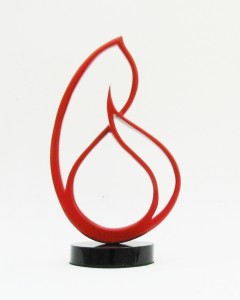
The sculpture is by artist Rita Blitt.  It stands ½ inch taller than the Oscar statue, and we think it is much more beautiful!

On behalf of WPA, I am happy to present Maestro Remmereit and the Rochester Philharmonic Orchestra with the AMY award for excellence in orchestral programming.

Everyone was so excited by this, and Maestro Remmereit was very moved. We didn’t get any pictures, but there is this one from the reception afterwards. But I am definitely going back in the fall!

ALSO:   Our Board plans to announce the details (on June 18) of another program to encourage including more works by women to the orchestral repertoire, our WPA Performance Grants.


RPO Honored with AMY Award

by sarah - June 2, 2012

Women’s Philharmonic Advocacy was delighted to award the Rochester Philharmonic Orchestra and conductor Arild Remmereit with the first ever AMY Award for Excellence in Orchestral Programming.

We have kept up with the RPO over the 2011-2012 season. During his first season with the ensemble, Remmereit set a wonderful precedent by programming eight works by historic and contemporary women. Liane Curtis, the WPA founder and president, made the trip to Rochester on Thursday to present the award, this beautiful sculpture designed by Rita Blitt.

You can read the RPO’s press release on the award here.

And do be sure to stop by Arild Remmereit’s Facebook page for photos of the maestro with Liane as well as with composer Margaret Brouwer, who was commissioned by the RPO. Her new work, Caution Ahead—Guard Rail Out was premiered on Thursday on a program that also included Sofia Gubaidulina’s Two Paths: A Dedication to Mary and Martha.

Congratulations to the RPO and Arild Remmereit! We look forward to more good work to come next season!

Fanny Hensel’s Cantata in Streaming Broadcast, May 7 at 8 pm

by Liane Curtis - May 6, 2012


The Rochester Philharmonic’s concerts are encored in streaming radio broadcast—

this concert (May 7,  2012 Monday, at 8 pm) starts with Fanny Hensel’s Cantata, “Job.”   Find the WXXI Classical 91.5 Stream Player here

http://interactive.wxxi.org/listen#fmstream

Here is the schedule for the Broadcasts   http://interactive.wxxi.org/rpo/listings

The Cantata is not very long (ca. 15 minutes), and then is follow by Mahler’s 2nd Symphony. The one CD of Hensel’s Cantata is now out of print, so this a rare opportunity to hear this work.


Rochester PO Announces 2012-13 Season

by Liane Curtis - March 2, 2012

The Rochester Philharmonic just announced its 2012-13 Season.  In his second season, Maestro Arild Remmereit will continue the orchestra’s exploration of great works by women, both historic and contemporary.

As we mentioned in our earlier post, we are thrilled to see the orchestra making this commitment to women. Remmereit recently served as keynote speaker at the annual fundraising luncheon of the Susan B. Anthony House and Museum. Emphasizing his commitment to women composers, he stated that music “is a necessity and shouldn’t just be in the hands of very few.”  What GREAT NEWS!  Happy Women’s History Month, but also nice to think that women aren’t only for March anymore!


New Beginnings!

by sarah - January 29, 2012

After an unexpected and far too lengthy hiatus, Feminist in the Concert Hall is back for the New Year. And what better way to start than with great news from the Rochester Philharmonic Orchestra.

I posted last year about the changes that the ensemble was going to have this season, both in conductor, as well as with programming.

New conductor Arild Remmereit was very clear in his intentions to diversify programming in the Season Announcement released in March 2010:

One of my passions is searching for under-appreciated or overlooked pieces that trigger in me an immediate emotional connection – works, which while unknown, are ones I believe musicians will love to play and audiences will love to hear. This is what I mean by ‘creating classics’.

His enthusiasm for this music is also evident when he speaks of the works:


The season opened with Amy Beach’s “Gaelic” Symphony in September. In October the RPO joined with the Eastman School of Music to present Fanny Mendessohn Hensel’s Hiob, (the review of which can be found here). November brought Gabriela Lena Frank’s Three Latin American Dances, and being presented the past two weekends is Peggy Stuart Coolidge’s Blue Planet.

Still to come are works by Karen Tanaka, Clara Schumann, Sofia Guabaidulina and a new piece by Margaret Brouwer.

I am delighted not only in the range and number of pieces being performed, but of the enthusiasm of Remmereit, which I have a feeling will continue. It was just announced that the RPO has been selected for the 2014 Spring For Music festival at Carnegie Hall.

The concert, scheduled for May 7, 2014, will feature Beach’s Symphony.

Kudos to the Rochester Philharmonic Orchestra!

by sarah - March 14, 2011

I recently wrote about the news from the Baltimore Symphony Orchestra that they are making a concerted effort to include and recognize the contributions of women musicians in their 2011-2012 concert season.  Just days after the BSO news was announced, I learned that the Rochester Philharmonic Orchestra is making similar strides in their programming.  The press release can be found here.

It is notable that this is the inaugural season for the RPO’s new Music Director, Arild RemmereitChristopher Seaman, Remmereit’s predecessor, was not known to embrace works by women in his programming – according to the League of American Orchestra reports the Rochester Philharmonic has only performed three works by women in the last ten years – (Higdon’s Blue Cathedral; Larsen’s Notes Slipped Under the Door, and Tower’s Fanfare for the Uncommon Woman).  This season, however, the RPO will perform eight works:

In my eyes, Remmereit has created a fantastic season including a more diverse representation of women’s work through history and nationalities than likely has ever been seen in a professional orchestra’s programming.  We can only hope that the effort and thought that was part of the artistic choices for the 2011-2012 season will carry through future seasons, and that Remmereit and the RPO will continue to perform diverse programming.  If this is how Remmereit is approaching his first season in Rochester, I am anxious to see what future concerts will hold!