by sarah - November 28th, 2008
In honor of the Thanksgiving holiday, NPR music commentator Miles Hoffman did a report on musical families for Morning Edition. The light piece, lasting about seven minutes, discussed the work of a few of the best known (or “most likely to be known”) women that were connected to the now seemingly legendary men.
Among the relatives mentioned were Maria Anna Mozart (who Wolfgang called Nannerl), Fanny Mendelssohn, and Clara Schumann. I found it unfortunate that in the discussion of the Bach family the only mention of Bach’s wives was the birth of twenty children – there was no reference to the musicianship or compositions of Anna Magdalena.
Fanny Mendelssohn’s Character Piece No. 2 for Piano and Clara Schumann’s Piano Trio in G Minor – Allegro Moderato were both heard in part during the broadcast, which can be heard here.
The seven minutes of light conversation did briefly address some of the obstacles that Fanny Mendelssohn faced as a composer from her family and the larger society, as well as the virtuosic abilities of Maria Anna Mozart and Clara Schumann. What they did not recognize was that this was the tip of a very large iceberg…
I also find it unfortunate that these talented women continue to be recognized primarily by their connection to more famous and (unfortunately) more respected men. I personally feel that the story, which was intended to be a fluff piece for the holiday, treated the few women mentioned as oddities, refusing to recognize the tradition and talent that continues to this day. But perhaps I am taking all of this a bit too personally – have a listen for yourself!
Filed: news, popular culture | Tagged: Clara Schumann, Fanny Mendelssohn, in the news, Maria Anna (Nannerl) Mozart, NPR | No Comments »
by sarah - November 21st, 2008
There has been a recent buzz about the list of the world’s top symphonies that Gramophone has put together. It seems to have taken many classical music enthusiasts by surprise that the top American orchestra (listed as number five) is the Chicago Symphony. The Cleveland Orchestra is listed as number seven.
The story and complete listings can be found via NPR here.
The rankings were determined after polling music critics from the United States, Europe and Asia who were asked to list their top 20 orchestras. James Inverne, editor for U.S. Gramophone suggests that the difference between Chicago and the rest of the U.S. Symphonies was their distinct sound – particularly the strength of the brass. Others have also credited Chicago with their excellent financial status, which is a rarity in most orchestras.
In my own research (that I have of about before, if only briefly) concerning the recent repertoire of the top American orchestras, the Chicago Symphony has stood out quite clearly from the rest. In fact, Chicago has received a gold star in my book by being the orchestra with the best track record for performing works by women composers – a total of 13 in the past 7 seasons, including works by Clara Schumann and Lili Boulanger, as well as commissioned works from Augusta Read Thomas (who was composer in residence from 1997-2006) and Melinda Wagner. This is a phenomenal record considering that most of the other ensembles I have looked at only report performing half the number of works by women, and of they consist almost exclusively of works written in the very recent past.
The Cleveland Orchestra, which was listed as number seven in the list of top 20, ranks just behind Chicago in the number of works by women performed in their recent seasons, totaling 10, though all recent compositions.
Though the factors that have led to the rankings appear to be largely subjective to personal opinion by music critics, I would like to think that these critics (at least in the United States) were also appreciative of varied repertoire. Even if it is only a happy coincidence, it is certainly worth noting.
Filed: awards, news, orchestras | Tagged: Augusta Read Thomas, Chicago Symphony, Clara Schumann, Cleveland Orchestra, Gramophone, in the news, Lili Boulanger, Melinda Wagner, repertoire | No Comments »
by sarah - November 17th, 2008
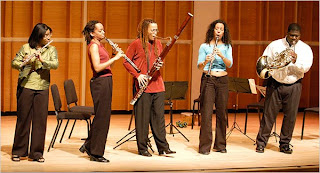
I recently wrote about how the lack of diversity in symphony orchestras, and the work that is being done by the Sphinx Organization to increase those numbers by encouraging the involvement of young African American and Latino musicians. Lucky for us – the New York Times recently reviewed a performance by Imani Winds.
(photo by Lee Tainer – New York Times)
The wind quintet, (Valerie Coleman, Toyin Spellman-Diaz, Monica Ellis, Mariam Adam and Jeff Scott) was founded ten years ago to expand the repertoire for wind quintets, as well as to introduce non-Western traditions. However, the founder of the ensemble, Ms. Coleman, also acknowledges that she specifically recruited members of black American and Hispanic heritage for the ensemble, precisely to counter the under-representation that is rampant. The ensemble also recently founded the Legacy Project to commission works from black, Hispanic, and Middle Eastern composers.
The ensemble is not only representative of the diversity that is largely missing from symphony stages, but is also making great strides in challenging the Canon. Their recordings include not only the standard quintet repertoire (composed by dead, white, men) but also new and interesting works, including arrangements by founder and flautist Valerie Coleman.
There is clearly a lot of work to be done before there will be fair representation in orchestras and ensembles – but there is certainly great work being done to get us there faster.
Filed: concerts, news | Tagged: diversity, Imani Winds, news, Sphinx Organization, the Canon | No Comments »
by sarah - November 15th, 2008
The London Times reported that Sir Peter Maxwell Davies has set text by Hildegard of Bingen in a new work: Liber Pulsationis Fabulatoris (which translates to, “The Book of Pulsations of the Creator of Legends.”) The piece was commissioned as part of the celebration for Liverpool 2008 European Capital of Culture and will be premiered at Liverpool’s Metropolitan Cathedral in December. It is also dedicated to Sir Paul McCartney.
The article (which can be found here) primarily details the friendship that has developed between Davies and McCartney and (unfortunately) discusses little of the actual work (for instance that it is a choral piece and 20 minutes in duration.) There is no reference to which of Hildegard’s numerous works the text is derived, and the article describes Hildegard only as “a 12th century German poet.” (I’m sure I’m not the only one who finds this to be a gross understatement!)
Regardless, it will be exciting and interesting to hear this new work and discover more about Davies’ choice of text, as well as what Hildegardians have to say about the piece …
Filed: concerts | Tagged: Hildegard of Bingen, premiere, Sir Peter Maxwell Davies | No Comments »